.png)
.svg)



.jpeg)
.jpeg)


.jpg)
Features
August 24, 2026
Ideal Customer Profile Bucketing: Do You Really Know Your Audience?




14 May 26
“Will AI take my job?”
If you’ve asked yourself this question even once, you’re not alone. When Tesla CEO Elon Musk says that AI and robots will replace all jobs and that humans will be free to grow vegetables, it certainly creates panic among professionals.
The last decade has seen a growing divide between those who favor and those who despise AI. Many often say that AI is not going to replace humans, but the brutal truth is: Yes, AI is replacing humans, and it's faster than you think. People thought AI was harmless until jobs started disappearing.
Recent large agency layoffs shocked everyone, and the worst is yet to come. It’s been around four months into 2026, and at least 23,000 jobs have already been lost to AI. The general impact is roughly the same across all domains.
This article will break down:
The answer to this question lies in these numbers given in the table below.
As per People Matters’ report, in 2025:
One of the main reasons behind these tech layoffs was increased investment in AI to reduce operational costs. Layoffs are happening and will continue. Recent talk of the town is Oracle layoffs. Last month, the company laid off around 30,000 employees globally, including 12000 staff in India. The Hindu reports that the next round of layoffs is going to happen soon.
So, to address the elephant in the room: is AI taking over jobs?
The clear-cut and honest answer is: Yes, it is.
The impact of AI on the job market is clear from the statistics. An important thing to know is that AI is not a single force wiping out employment overnight. Instead, it’s slowly automating specific tasks within jobs.
According to BCG, AI is affecting the job market in the following ways:
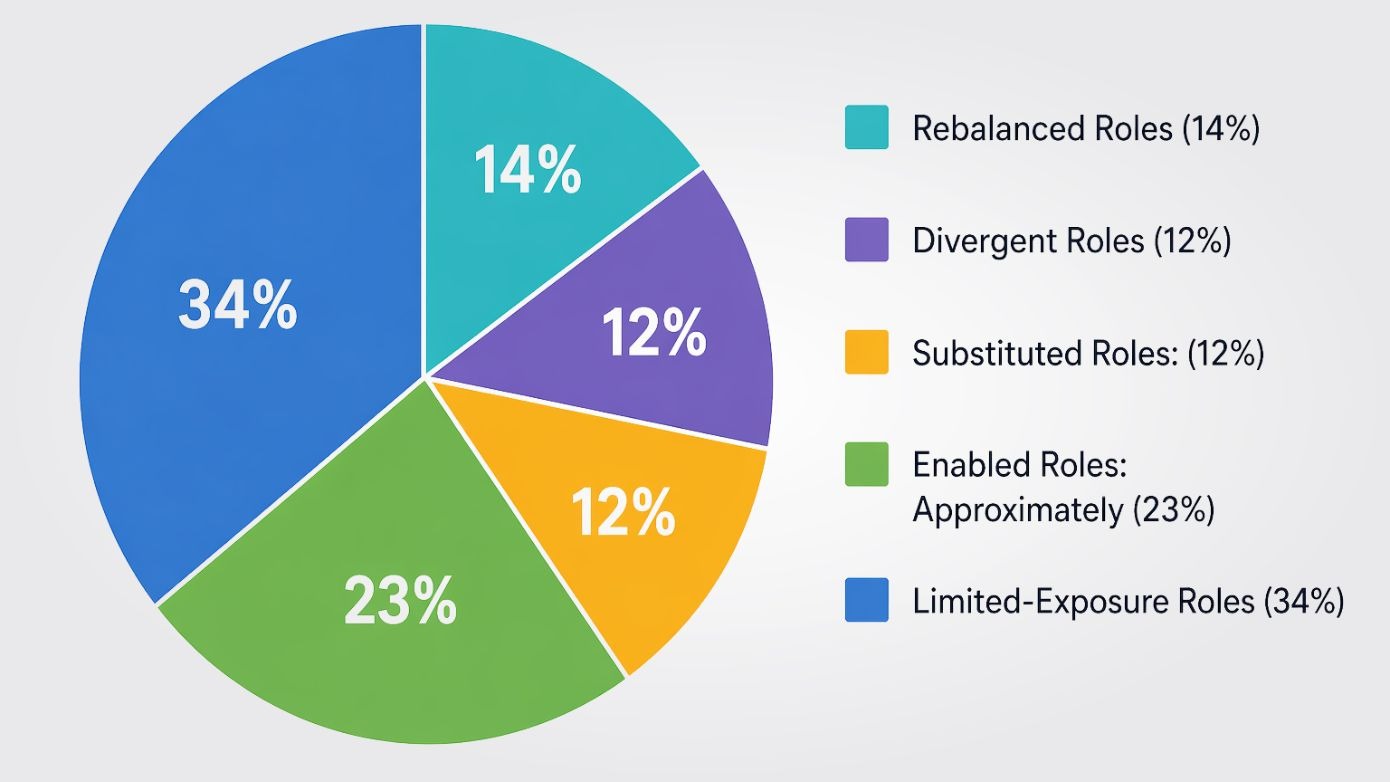
The exact number is difficult to predict, but the National University of California states that 300 million jobs could be lost to AI globally, representing 9.1% of all jobs worldwide.
On the other hand, according to Nexford University, Artificial Intelligence will replace:
The number of jobs is surely reducing, but their complete disappearance is still far from. Apparently, women may face a higher risk of automation driven by AI because of their higher representation in clerical and other administrative roles. This brings us to another important question: What types of jobs will be replaced by AI?
AI tends to replace or disrupt jobs that involve:
Tasks that involve repetitive and structured actions with minimal variation are highly vulnerable. Such tasks can be easily automated as they follow clear patterns. Hence, AI systems can easily learn and execute them faster. If your work doesn't require creativity or complex decision-making, then AI can perform it faster, cheaper, and with fewer errors.
AI is increasingly handling roles that rely on fixed rules, predefined logic, and standardized workflows. These involve data processing and condition-based decision-making. AI can now complete such tasks efficiently at scale. Therefore, industries like finance, insurance, and legal operations are seeing growing automation in such roles.
Generative AI is being used at a large scale in basic content, designs, and code. AI has made its way into our everyday lives, and Gen AI is heavily used in creative marketing. Recent ChatGPT caricature and Gemini Nano banana trends are a few examples.
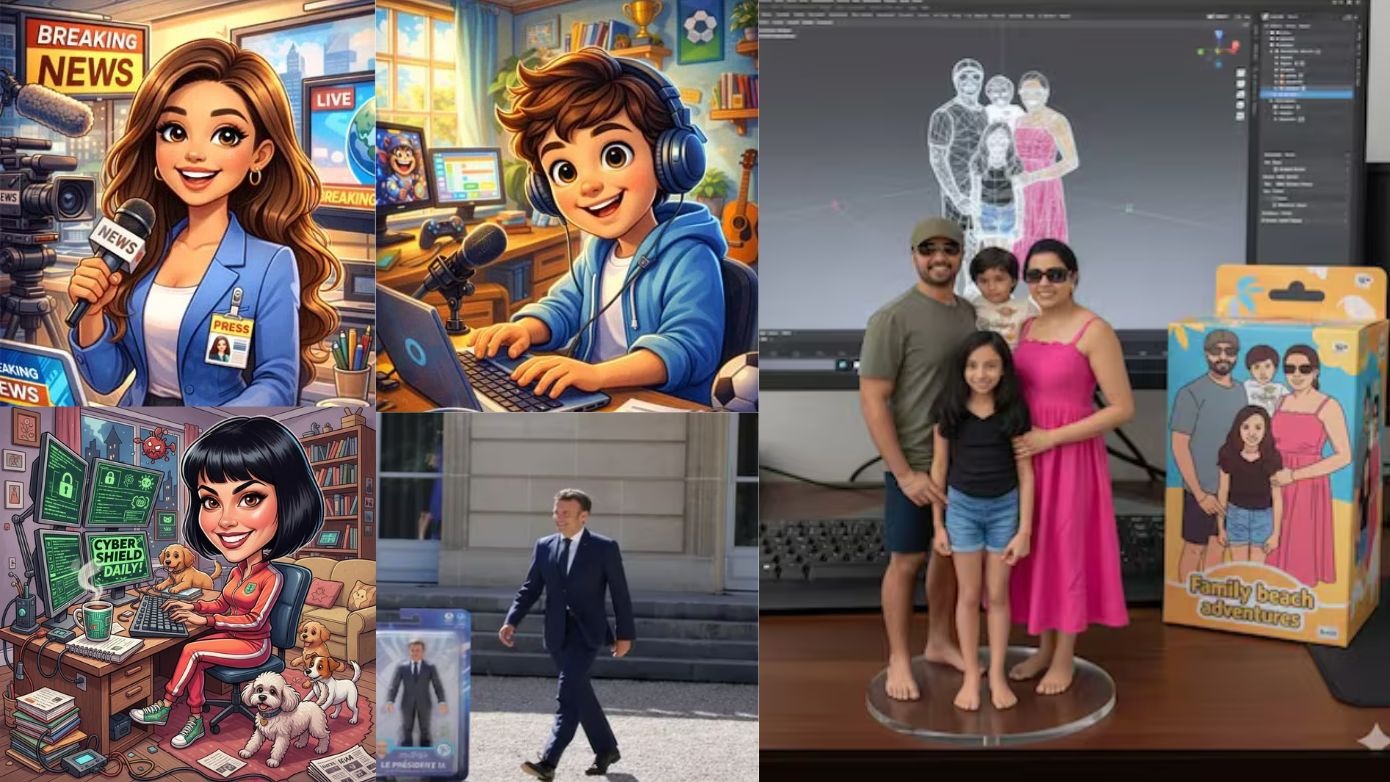
Therefore, tasks that don’t require deep creativity, originality, or strategic thinking are especially at risk. AI-generated outputs may not always be perfect, but they are often considered “good enough”. Hence, it reduces the demand for entry-level or routine production work.
Here are some job roles that are at most risk:
But something you should know is that AI replaces tasks, not entire professions. If you are skilled enough to use AI to your advantage, then you can actually benefit from the current job market chaos. For example, a skilled content strategist won’t be replaced, but a generic article writer might struggle.
This brings us to another question: What jobs are not at risk from AI? The answer lies in the next section.
Now for the reassuring part: what jobs will AI not replace? AI is still in its growth and development years and struggles with a lot of things. For now, these types of job roles are the least at risk from AI.
AI tends to struggle with jobs that involve originality, imagination, and out-of-the-box thinking. These characteristics are difficult for AI to fully replicate. No doubt, AI can assist in generating ideas or speeding up the process, but it cannot create truly original concepts rooted in human experiences.
Additionally, AI needs to be fed with good-quality data or content to give better results. There’s a popular term in AI, "garbage in, garbage out" (GIGO). It refers to the principle that the quality of output is determined by the quality of the input.
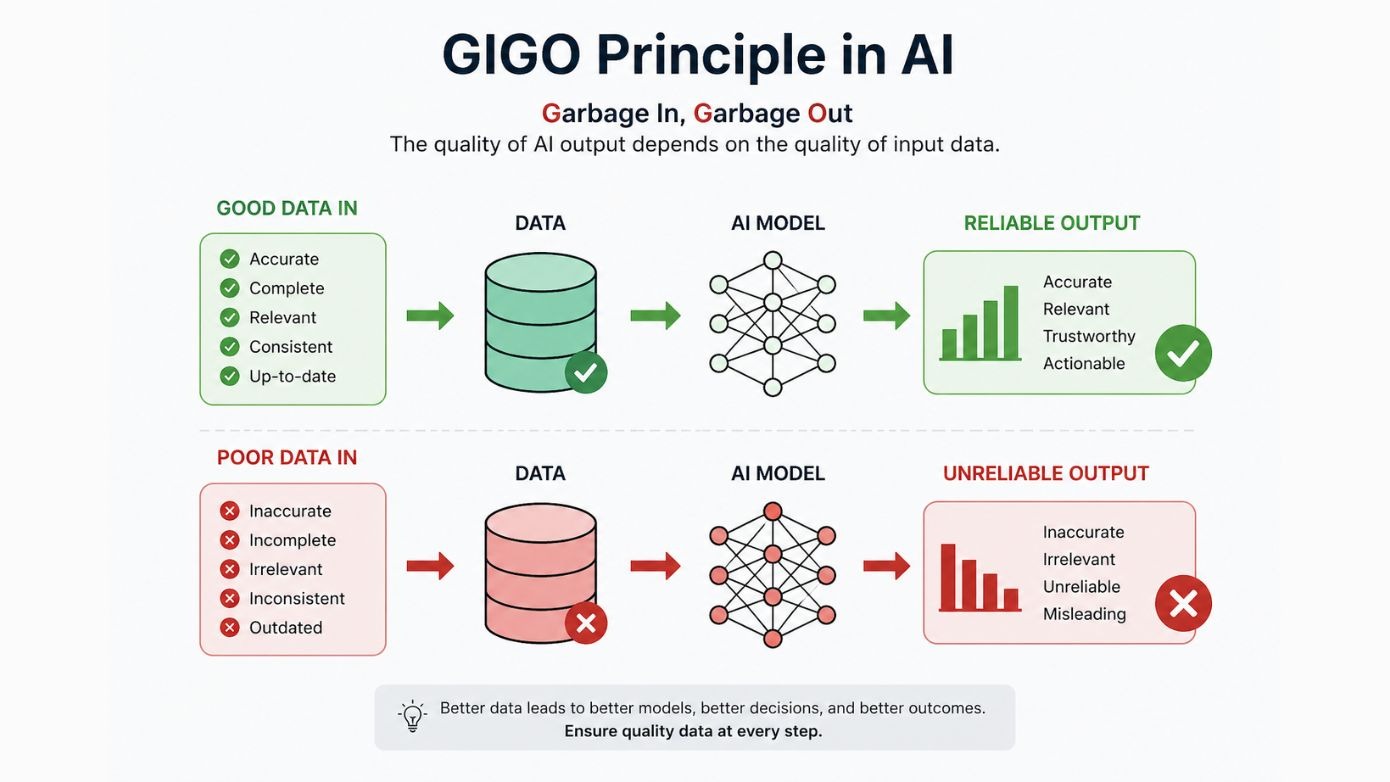
In other words, if poor-quality training data is fed to AI models, then the output will be poor as well. Because of these limitations, AI still relies on human creativity to guide and refine its outputs. Hence, strategic thinking, brand storytelling, and creative direction still depend heavily on human insight and vision.
AI doesn’t have empathy, emotional intelligence, or personal connection. Hence, job roles that rely on these characteristics are among the safest. AI cannot genuinely understand human emotions or build meaningful relationships. The urge to tell all your problems to ChatGPT is understandable, but AI will never truly feel your feelings.
Professions like teaching, therapy, and healthcare require trust, compassion, and nuanced communication. These types of job roles are still safe as machines are far from mastering human emotions and connections in real-world scenarios.
Leadership roles involve judgment, accountability, and long-term vision. AI still can’t fully imitate these qualities. To make complex decisions, you must balance data with intuition, ethics, and experience. You must navigate uncertainty and confidently lead people. This is something AI tools can support but not replace.
Jobs that require hands-on work in unpredictable environments are difficult to automate. Skilled trades require adaptability, precision, and real-time problem-solving in physical settings. Robotics is advancing, but it still lacks sensory perception and general intelligence. They also struggle with the flexibility and situational awareness that humans bring to these professions.
According to World Economic Forum and US Career Institute, here are some job roles that are least at risk:
AI is replacing jobs to a significant extent, but AI cannot replace what makes you human. If your job combines creativity, emotional intelligence, and complex problem-solving, then you are still the safest in the long run. AI is still in its baby phase. It can generate outputs but can’t feel, experience, or truly understand.
Another important point to note is that AI won’t replace you, but someone using AI might. Employers want skilled professionals who know how to efficiently use AI. You have to adapt yourself to new technologies or risk being replaced. Many professionals are upgrading themselves or have entirely changed their domain.
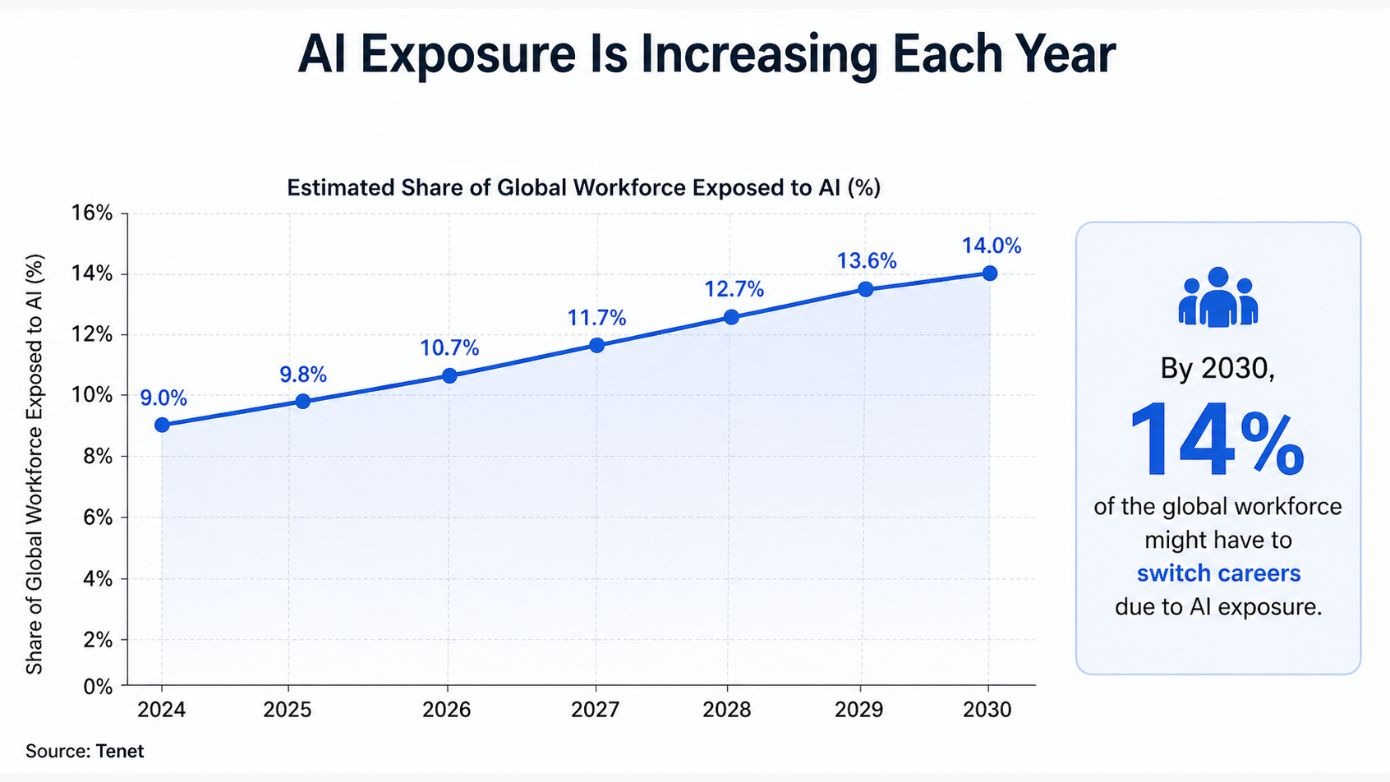
According to resources, exposure to AI continues to increase each year, rising by around 9% annually, and by 2030, approximately 14% of the global workforce might have to switch careers. In fact, in advanced economies, AI can impact 60% of jobs, increasing the pressure to adapt.
Times are changing, and the future is uncertain. Humanity is moving towards a more advanced and sophisticated era of artificial intelligence. Some people argue that “everything that you do can be done better by AI,” but AI still can't replace your originality and emotions. AI still makes mistakes.
Every technology brings certain positive and negative impacts. When the Industrial Revolution came, it displaced traditional workers but also created many new jobs. Well, the debate over whether machines are job liberators or destroyers will continue for the coming years, but AI has also created new job opportunities.
The 2025 World Economic Forum Future of Jobs Report states 92 million jobs might be eliminated by 2030. However, adoption of AI will also create 170 million new roles, resulting in a net gain of 78 million.
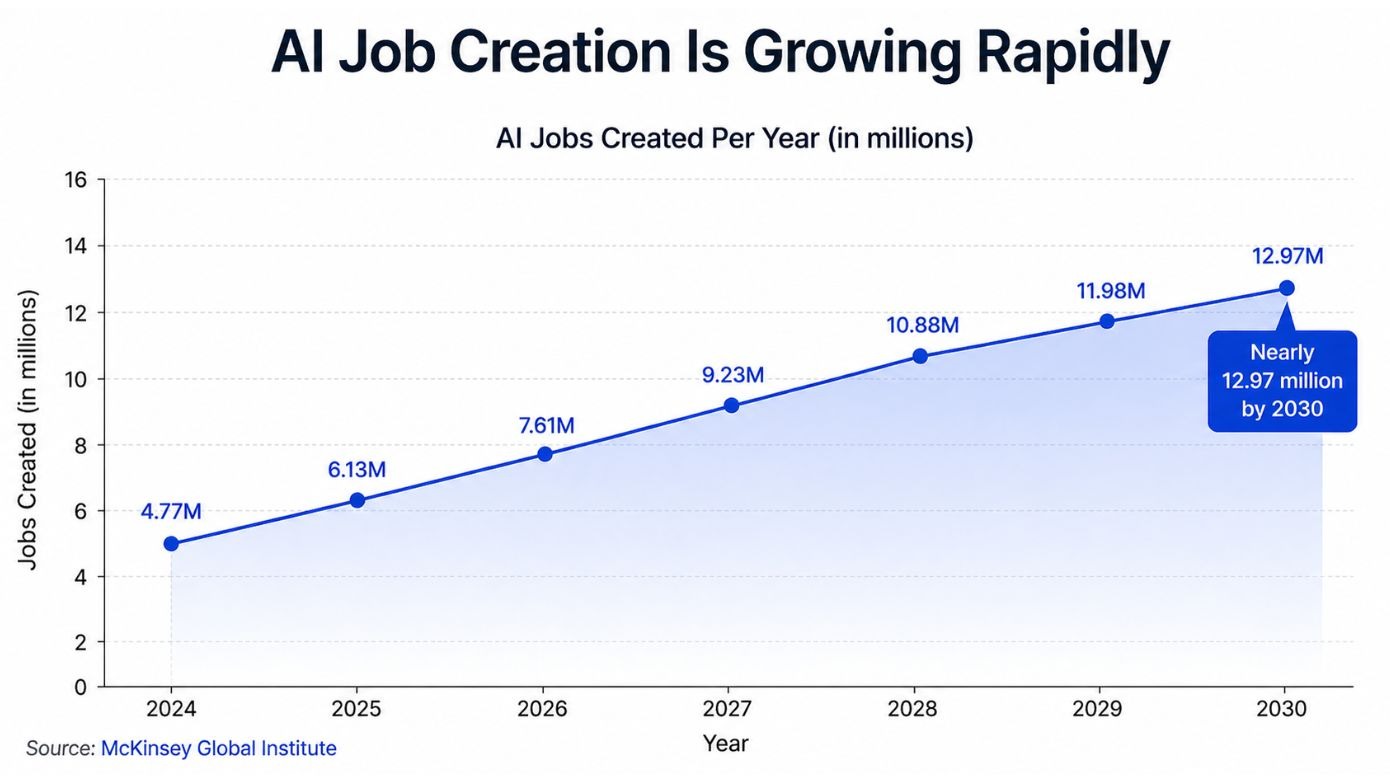
Additionally, McKinsey reports that AI job creation will increase over time, with an estimated annual growth rate of 20%. It mentions that approximately 4.77 million are created per year and will grow to nearly 12.97 million by 2030.
These statistics bring us to another curious question: What jobs are getting created because of AI?
Some new job roles emerging due to AI are:
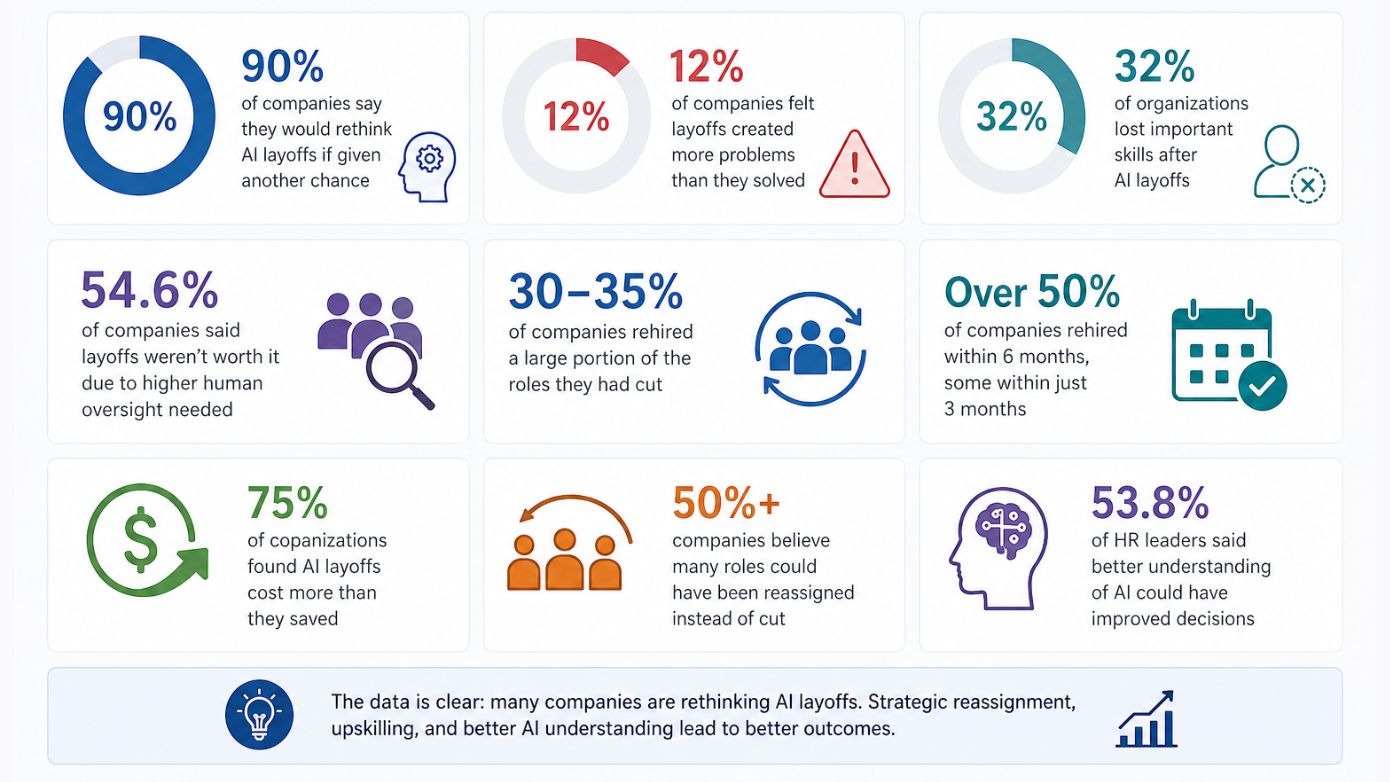
Interestingly, some companies that massively reduced their headcounts while citing AI adoption as the reason are facing critical issues. Fortune highlights that AI layoffs have damaged company culture, and many CHROs feel that they lacked strategic intent when firing employees.
An increasing number of companies are realizing that automation alone cannot fully replace the skills, oversight, and institutional knowledge previously provided by employees. In Feb 2026, CareerMinds surveyed 600 HR professionals who made AI-based layoffs in the last 12 months and found these insights:
Here’s another classic example of AI layoff backfiring for you:
Klarna, a Swedish fintech, reduced its employees from 5,500 to just 3,400 by the end of 2023. The company publicly bragged that AI could do all of the jobs humans do. They even celebrated $10 million in savings. But their joy soon turned into regret as customer satisfaction fell sharply. Complaints began to increase, and cracks began to appear.
By mid-2025, Klarna started rehiring those roles that were considered better without humans. Klarna isn’t alone in this journey of self-reflection and realization. Many are experiencing the AI whiplash. Companies that replaced their workers with AI regret everything.
“
AI simply isn’t mature enough to fully replace the expertise, empathy, and judgment that human agents provide. Relying solely on AI right now is premature and could lead to unintended consequences.
“
~ Emily Potosky (Senior Director of Research for Gartner Customer Service & Support) to Inc.
MIT Media Lab’s Study (The GenAI Divide: State Of AI In Business 2025) highlights that despite $30 billion to $40 billion spent developing or purchasing AI platforms over the past two years, only 5 percent of the companies involved reported any return on their investment. 95% of enterprises are getting zero return.
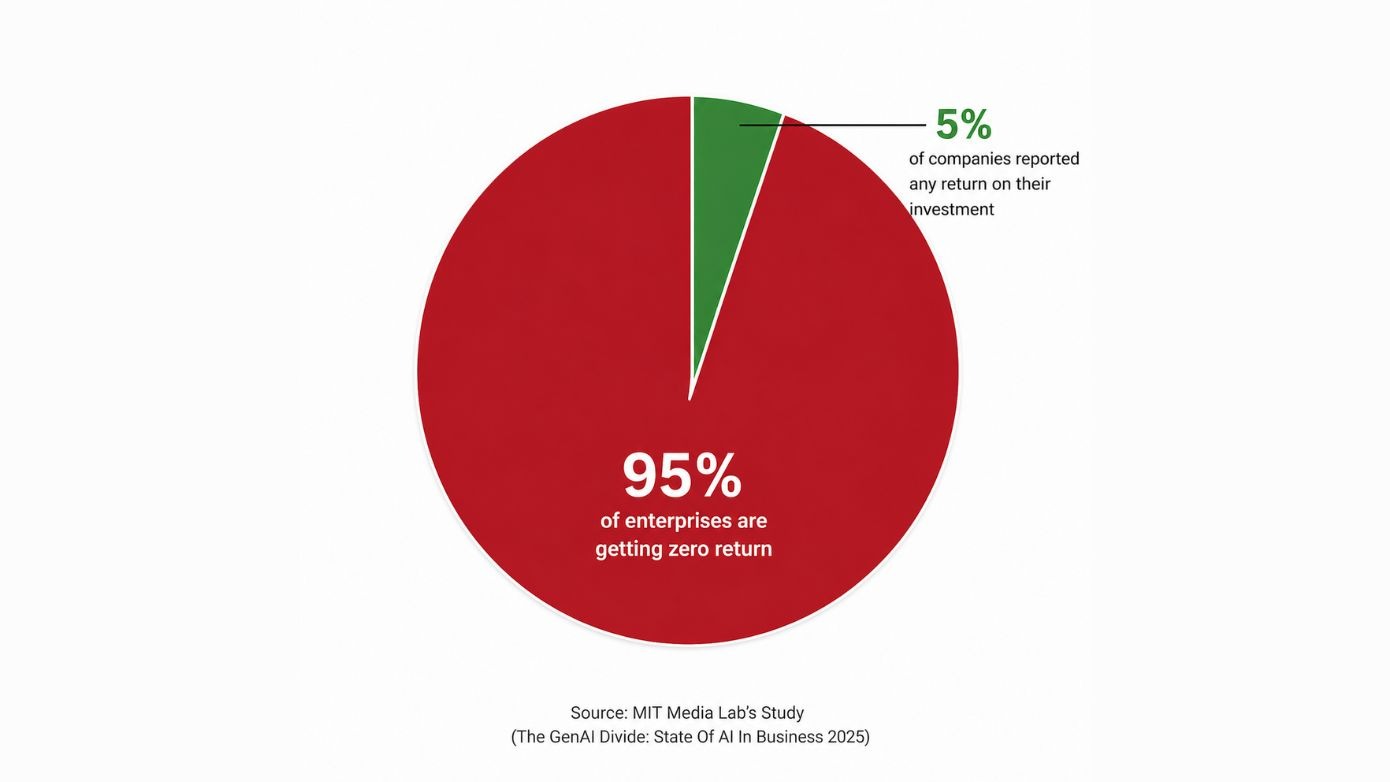
In fact, 50% of businesses abandoned AI projects after early testing due to poor data, high costs, and unclear value. Many companies rushing into AI adoption are now facing this reality check. While AI can boost productivity, relying on it entirely is premature. The smarter approach is to use AI as a tool to support employees, not replace them.
“
Companies should think less about cuts and instead focus on redeployment. AI can’t replace human judgement, and companies that use it as a cover for massive layoffs are being ‘shortsighted’.
“
~ Niki Armstrong (CALO at Everpure) and Jolen Anderson (CPCO at BetterUp)
The answer is: Yes and No.
No doubt, AI is reducing jobs. Some roles are fading, others are evolving, and entirely new ones are emerging. AI is growing and becoming sophisticated. Change is inevitable, and like every coin has two sides, AI has two sides. Every major technical shift in history has brought both positive and negative effects.
Some people believe: “Everything you do can be done better by AI.” But that’s a completely wrong notion. AI can replicate patterns, optimize processes, generate content, etc. However, it cannot replace your originality, emotions, and lived experiences.
Honestly, nothing can be said with certainty. But currently, the fear around AI replacing humans and eating their jobs is a little exaggerated. Forrester’s 2026 Future of Work outlook predicts that half of AI-attributed layoffs would be quietly reversed by 2027.
The smart move for everyone is to learn how to work with AI and upskill themselves for the road ahead. The future of the job market is volatile and will be hugely impacted by AI, but Klarna’s lesson clearly shows that replacing humans entirely with AI might be harder (and messier) than it looks.
1. Will AI take my job completely?
AI is unlikely to completely replace most jobs, but it will automate certain tasks within them. Roles involving repetitive work are more at risk, while creative and strategic roles remain safer. Adapting and learning AI tools can significantly reduce your risk of being replaced.
2. What jobs are AI going to replace first?
AI is most likely to replace jobs involving repetitive, rule-based tasks such as data entry, customer support, and basic content creation. Entry-level roles are more vulnerable, especially those that do not require creativity, emotional intelligence, or complex decision-making skills.
3. What jobs are least at risk from AI?
Jobs that require creativity, emotional intelligence, and human interaction are the least at risk. These include roles in healthcare, education, leadership, skilled trades, and creative industries where human judgment, empathy, and originality are essential.
4. How is AI impacting the job market?
AI is reshaping the job market by automating repetitive tasks, enhancing human productivity, and creating new job roles. While some jobs are being reduced, many are evolving, and new opportunities are emerging in AI-related and hybrid roles.
5. What jobs are getting created because of AI?
AI is creating roles like AI engineers, data scientists, prompt engineers, AI ethics specialists, and hybrid roles such as AI-powered marketers. These jobs focus on building, managing, and working alongside AI systems rather than competing with them.
Marketing technology content specialist with 4+ years of experience creating research-driven content for the EdTech and B2B SaaS space. Passionate about simplifying complex MarTech concepts through strategic storytelling, audience-focused writing, and data-backed insights.


Copyright © 2025 CMGalaxy | All Rights Reserved.


